
The Future of Spatial Medicine
Offline-First AI, Sovereign Intelligence, and the Rise of Edge-Driven Healthcare Ecosystems.
From Digital Health to Offline-first Spatial Medicine
Healthcare in 2026 is undergoing a structural shift—from centralized, cloud-dependent systems to spatial medicine, where care is delivered across distributed, real-world environments. This evolution is driven by artificial intelligence (AI), edge computing, and the urgent need to serve low-connectivity, remote, and high-risk environments.
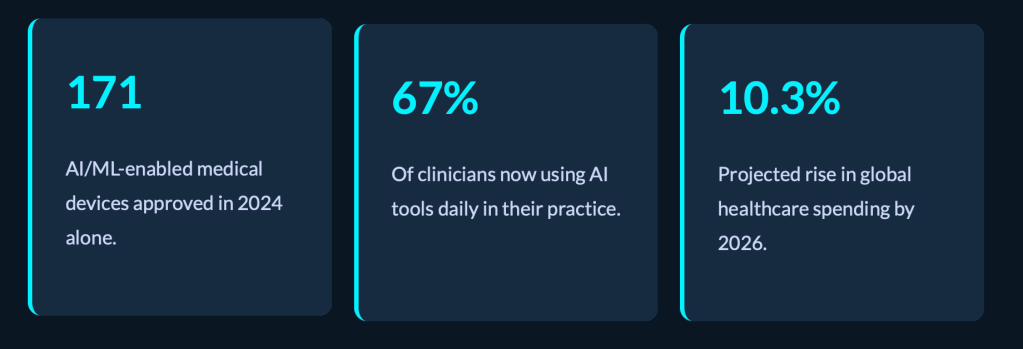
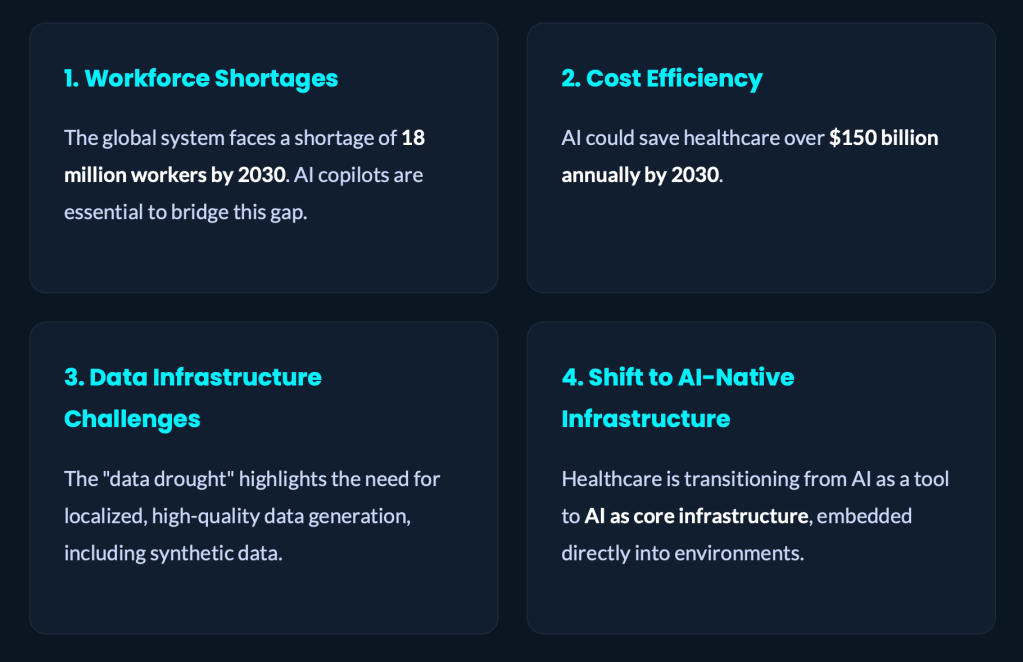
Global trends confirm this shift. Healthcare AI adoption has accelerated rapidly, with 171 AI/ML-enabled medical devices approved in 2024 alone , and 67% of clinicians already using AI tools daily . At the same time, healthcare spending is projected to rise by 10.3% globally in 2026, driven largely by new technologies. Yet a paradox remains: while AI capabilities expand, 81% of U.S. hospitals still report zero AI deployment in production environments. The bottleneck is no longer innovation—it is infrastructure, connectivity, and trust. This is where NeutronTech.ai enters the landscape.
What Is Spatial Medicine?
Spatial medicine refers to healthcare systems that operate across physical environments, integrating:
- Real-time patient data
- Environmental and geospatial context
- AI-driven decision-making at the edge
Unlike traditional telemedicine, spatial medicine emphasizes localized intelligence—AI systems that function without reliance on constant internet connectivity.
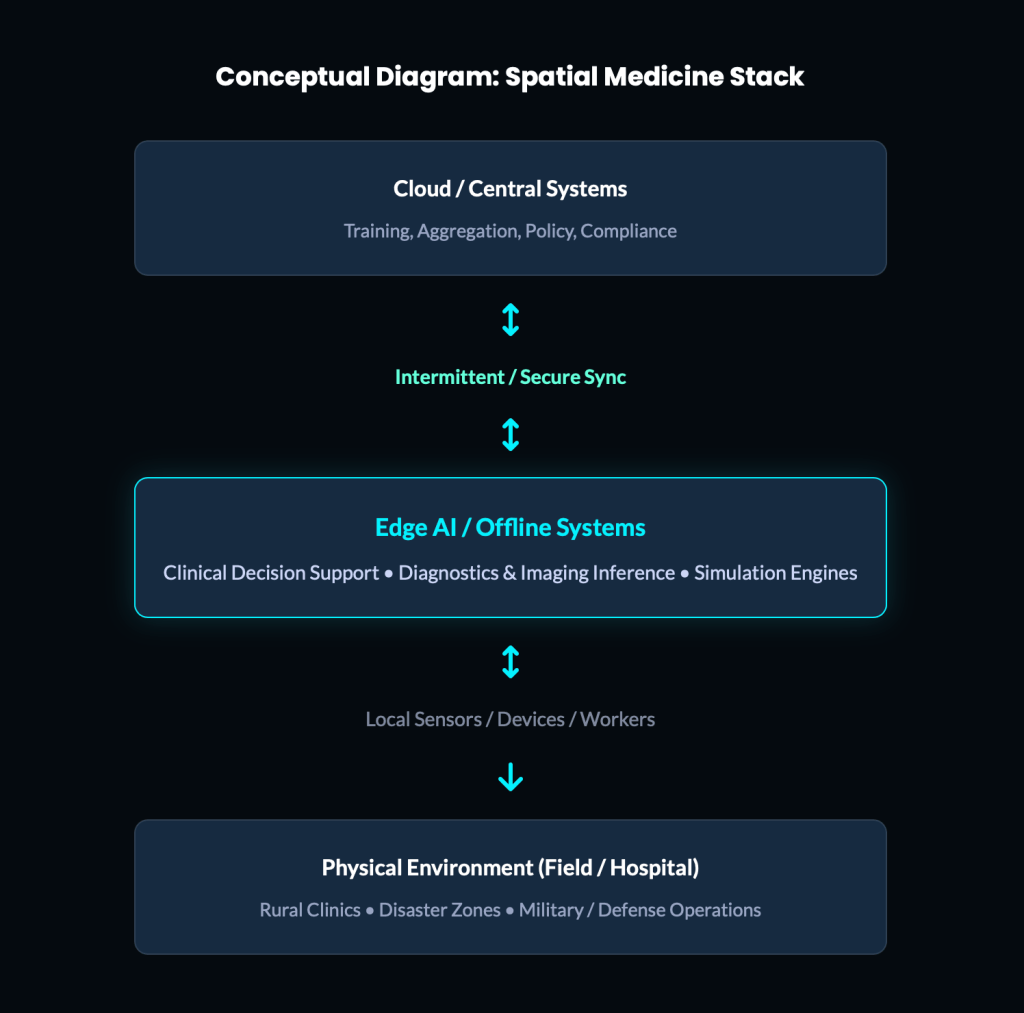
NeutronTech.ai and the Rise of Offline-First Healthcare
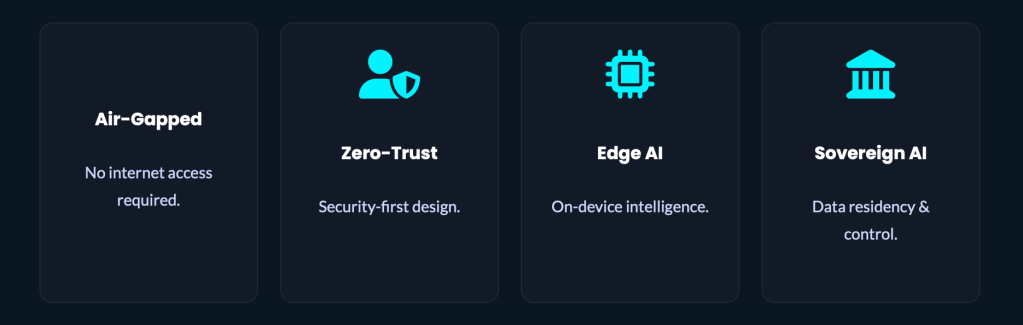
NeutronTech.ai is positioning itself at the center of this transformation by building offline-first AI infrastructure designed for:
Why Offline-First Matters
Healthcare systems increasingly operate in environments where connectivity is unreliable or restricted:
- Rural and underserved regions
- Emergency response zones
- Military and defense healthcare
- Mobile clinics and field hospitals
In these contexts, cloud-dependent AI fails. Offline-first AI ensures:
- Continuous operation without internet
- Lower latency for critical decisions
- Enhanced privacy and compliance
- Resilience against cyber threats
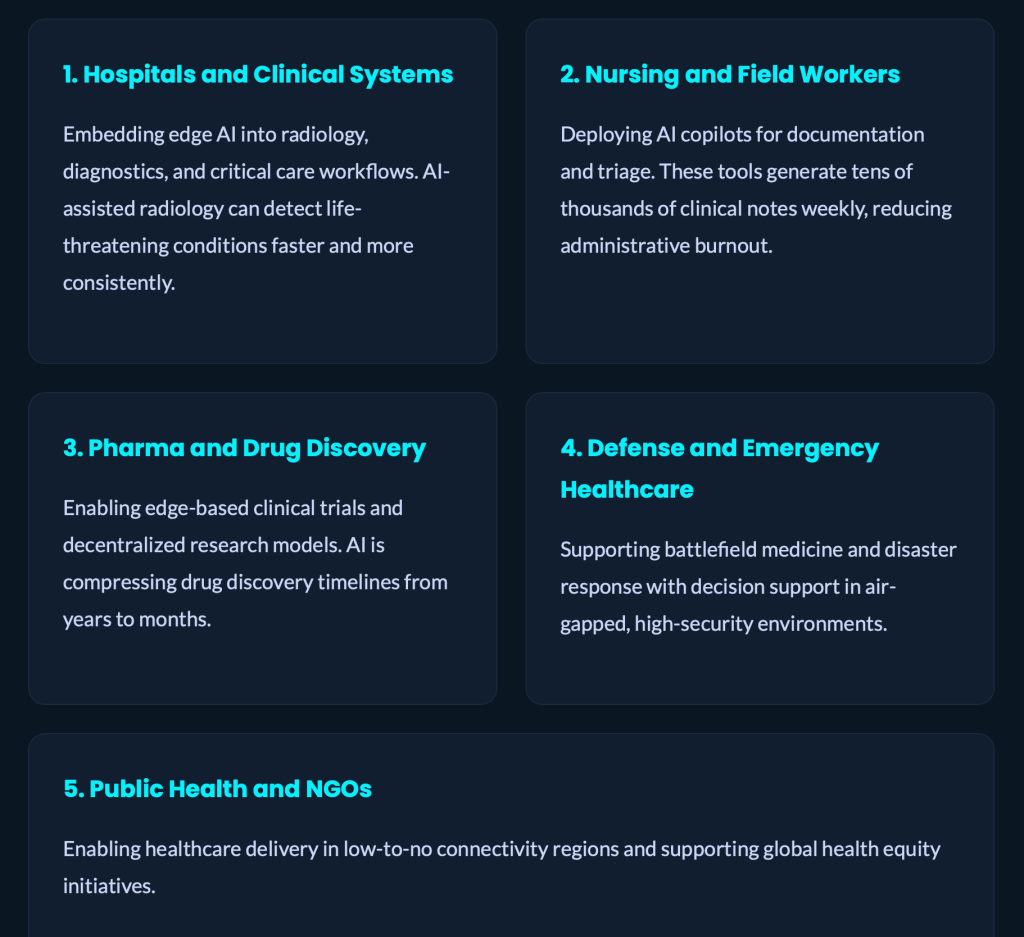
This aligns with broader industry concerns: 39% of healthcare organizations cite data privacy and sovereignty as top barriers to AI adoption. NeutronTech.ai’s strategy integrates across the entire healthcare value chain:
Core Technologies Powering the Platform
1. Edge AI and On-Device Inference
AI models run directly on local devices, eliminating dependency on cloud inference.
2. Sovereign AI
Data remains within jurisdictional boundaries, addressing regulatory and compliance requirements.
3. Zero-Trust Architecture
Every interaction is authenticated and verified, reducing risk in sensitive healthcare environments.
4. Air-Gapped Systems
Fully isolated systems for defense-grade security and mission-critical operations.
The Next Frontier: Offline-First Healthcare Simulation Engines
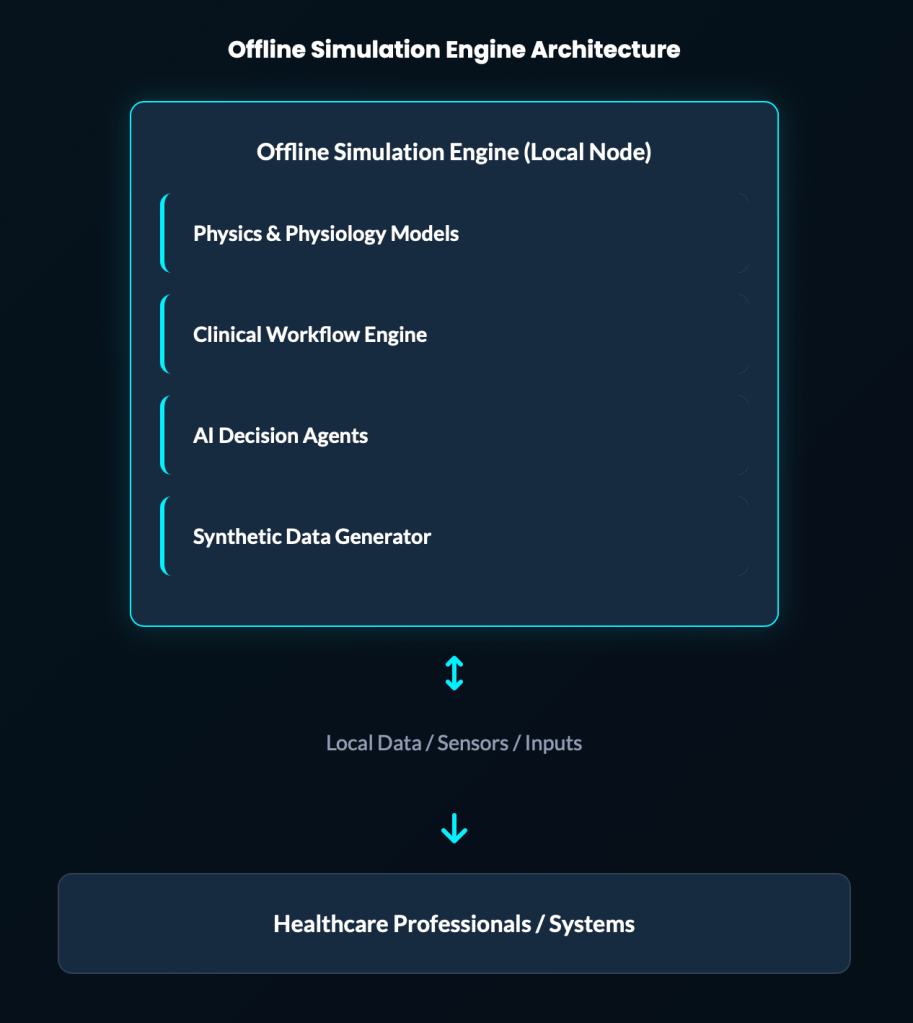
One of NeutronTech.ai’s most ambitious initiatives is the development of offline-first healthcare simulation engines.
What Are Healthcare Simulation Engines?
Simulation engines create digital replicas of real-world clinical environments, enabling:
- Training for healthcare professionals
- Testing of clinical workflows
- Synthetic data generation for AI models
- Scenario planning for emergencies
Why Offline Simulation Matters
Most current simulation platforms rely on cloud infrastructure. NeutronTech.ai’s approach enables:
- Deployment in secure or disconnected environments
- Real-time simulation in field conditions
- Training in rural or resource-constrained settings
Example Use Cases
- Military medical training in air-gapped systems
- Rural nurse training without internet access
- Pandemic scenario modeling in isolated regions
- Pharmaceutical trial simulations with localized data
Challenges Ahead
Despite its promise, spatial medicine faces key challenges including regulatory fragmentation across regions, model validation in offline environments, hardware constraints for edge deployment, and trust/explainability in AI decisions. These are being addressed through federated learning, simulation, and sovereign AI frameworks.
The Strategic Advantage of NeutronTech.ai
Our differentiation lies in combining offline-first architecture, defense-grade security, edge-native AI, and cross-sector partnerships. This positions NeutronTech.ai as the infrastructure for the next generation of healthcare systems.
Conclusion: Toward a Distributed Future of Medicine
The future of healthcare in 2026 is not centralized—it is distributed, resilient, and spatially aware. As AI continues to evolve, the winners in healthcare will not be those with the largest models, but those who can deploy intelligence where it is needed most: at the bedside, in the field, in disconnected environments, and across global healthcare systems.
NeutronTech.ai’s focus on offline-first, edge-native, and sovereign AI represents a critical step toward this future—one where healthcare is no longer limited by connectivity, but empowered by localized intelligence and global collaboration.
References
Bessemer Venture Partners. (2026). State of Health AI 2026. Retrieved from https://www.bvp.com/atlas/state-of-health-ai-2026
Directio. (2026). The Future of Healthcare in 2026: AI, Data and Experience Engineering. Retrieved from https://www.directio.com/blog/the-future-of-healthcare-in-2026-ai-data-and-experience-engineering/
HealthTech Magazine. (2026). Tech Trends: Healthcare IT Leaders Get Real About the State of AI in 2026. Retrieved from https://healthtechmagazine.net/article/2026/01/tech-trends-healthcare-it-leaders-get-real-state-ai-2026
Stabilarity Hub. (2026). AI in Healthcare 2026: From Research Settings to Real-World Impact. Retrieved from https://hub.stabilarity.com/ai-in-healthcare-2026-from-research-settings-to-real-world-impact/
Quad One. (2026). AI in Healthcare 2026: Top 10 Trends Reshaping the Future of Medicine. Retrieved from https://www.quadone.com/ai-in-healthcare-2026-top-10-trends-reshaping-the-future-of-medicine/
Itera Research. (2026). AI Healthcare Trends 2026. Retrieved from https://www.itera-research.com/ai-heathcare-trends-2026/
EU-Startups. (2026). AI in 2026: The Data Drought, Healthcare Opportunities, and Space Tech. Retrieved from https://www.eu-startups.com/2026/02/ai-in-2026-the-data-drought-healthcare-opportunities-and-space-tech/
TechTich. (2026). AI Healthcare 2026 Guide. Retrieved from https://techtich.com/ai-healthcare-2026-guide/
U.S. Food and Drug Administration (FDA). (2024). Artificial Intelligence and Machine Learning (AI/ML)-Enabled Medical Devices. Retrieved from https://www.fda.gov/medical-devices/software-medical-device-samd/artificial-intelligence-and-machine-learning-aiml-enabled-medical-devices
World Health Organization (WHO). (2023). Global Health Workforce Shortage Projection. Retrieved from https://www.who.int/news-room/fact-sheets/detail/health-workforce
McKinsey & Company. (2023). The Potential for Artificial Intelligence in Healthcare. Retrieved from https://www.mckinsey.com/industries/healthcare/our-insights/the-potential-for-artificial-intelligence-in-healthcare
Stanford Medicine. (2024). AI Index Report: Healthcare Sector Insights. Retrieved from https://aiindex.stanford.edu
Deloitte. (2025). Global Health Care Outlook 2025. Retrieved from https://www2.deloitte.com

Listen to Josh on the future of Sovereign & Offline-first AI

 NeutronTechAI Blog
Leave a comment